
OpenClaw: Powering the Next Generation of AI Agent Orchestration
Discover OpenClaw, the innovative modular system designed to unify AI agents into powerful, automated workflows. Learn how GPU infrastructure and distributed computing accelerate data analysis and business automation.
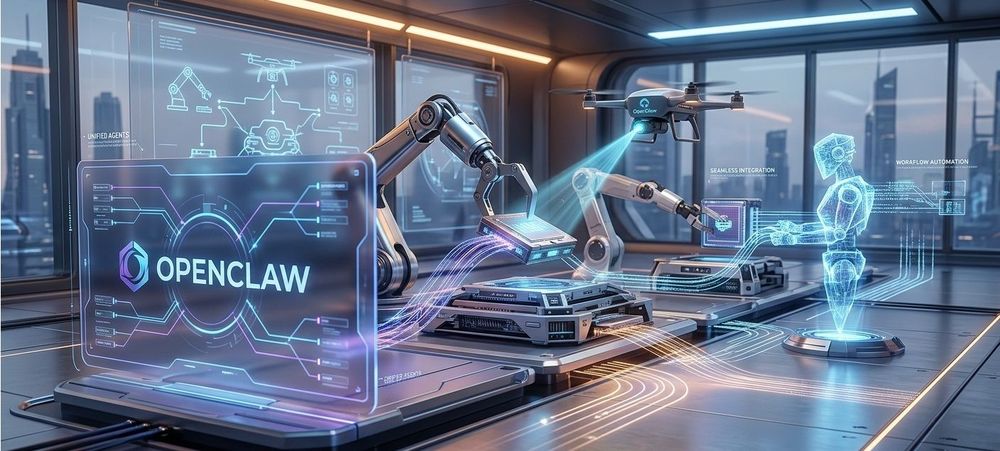
OpenClaw is an innovative system designed to unify diverse artificial intelligence agents into cohesive, high-performance workflows. Simply put, it enables different neural networks to "communicate" with one another, automatically structuring their interactions to solve complex challenges—ranging from deep data analytics to sophisticated content generation and business process automation.
This solution is particularly critical for enterprises managing massive datasets that require rapid computational scaling. To maintain the stability of a system like OpenClaw, businesses rely heavily on GPU servers and on-demand compute rentals, which provide the raw power necessary for these advanced operations.
How OpenClaw Works
The system is built on a modular agent architecture. Each individual agent is specialized for a specific type of task—such as natural language processing, image analysis, or autonomous decision-making. OpenClaw synchronizes these agents to create a flexible, goal-oriented workflow tailored to the user's specific needs. This makes it an essential tool for both R&D laboratories and tech companies focused on machine learning (ML).
The standout feature of OpenClaw is its high adaptability. The system dynamically distributes tasks among agents in real-time based on current workloads and available hardware. When integrated with high-end GPU servers or flexible GPU rentals, performance scales exponentially, allowing for zero-latency data processing.
Key Advantages of OpenClaw
- Time Efficiency: Automatically constructs complex workflows between disparate neural networks, saving significant engineering hours.
- Flexibility: Seamlessly plug new models and agents into existing pipelines without overhauling the architecture.
- Scalability: Full support for distributed computing and dedicated GPU infrastructure.
- Interoperability: OpenClaw integrates out-of-the-box with leading ML frameworks and major cloud platforms (AWS, Azure, Google Cloud).
- Professional Note: While OpenClaw automates the workflow, the resulting data insights require professional interpretation. Experienced specialists remain essential for the final evaluation and correct application of processed data.
The Role of Compute Power and GPUs
To reach its full potential, OpenClaw demands significant hardware resources. The system reaches peak efficiency when deployed on clusters utilizing GPU rentals or dedicated compute instances. This hardware acceleration speeds up complex calculations, improves model accuracy, and drastically reduces time-to-insight.
Utilizing a robust GPU infrastructure not only drives performance but also ensures system resilience. OpenClaw can redistribute tasks across available power in real-time, automatically optimizing the load for maximum stability.
Conclusion
OpenClaw is more than just an automation tool; it is an intelligent orchestrator that transforms fragmented AI processes into a unified, high-IQ system. For peak stability, the platform requires a reliable computational foundation, typically accessed through specialized GPU servers or cloud-based GPU rentals. Systems of this caliber offer businesses a competitive edge in data analysis, automation, and overall technological efficiency.